HammerDo.com
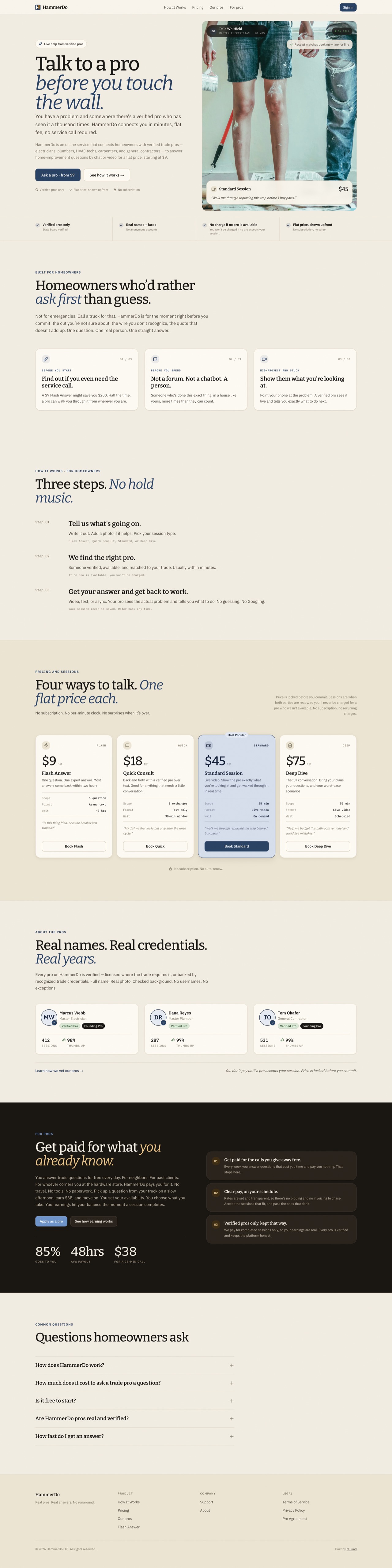
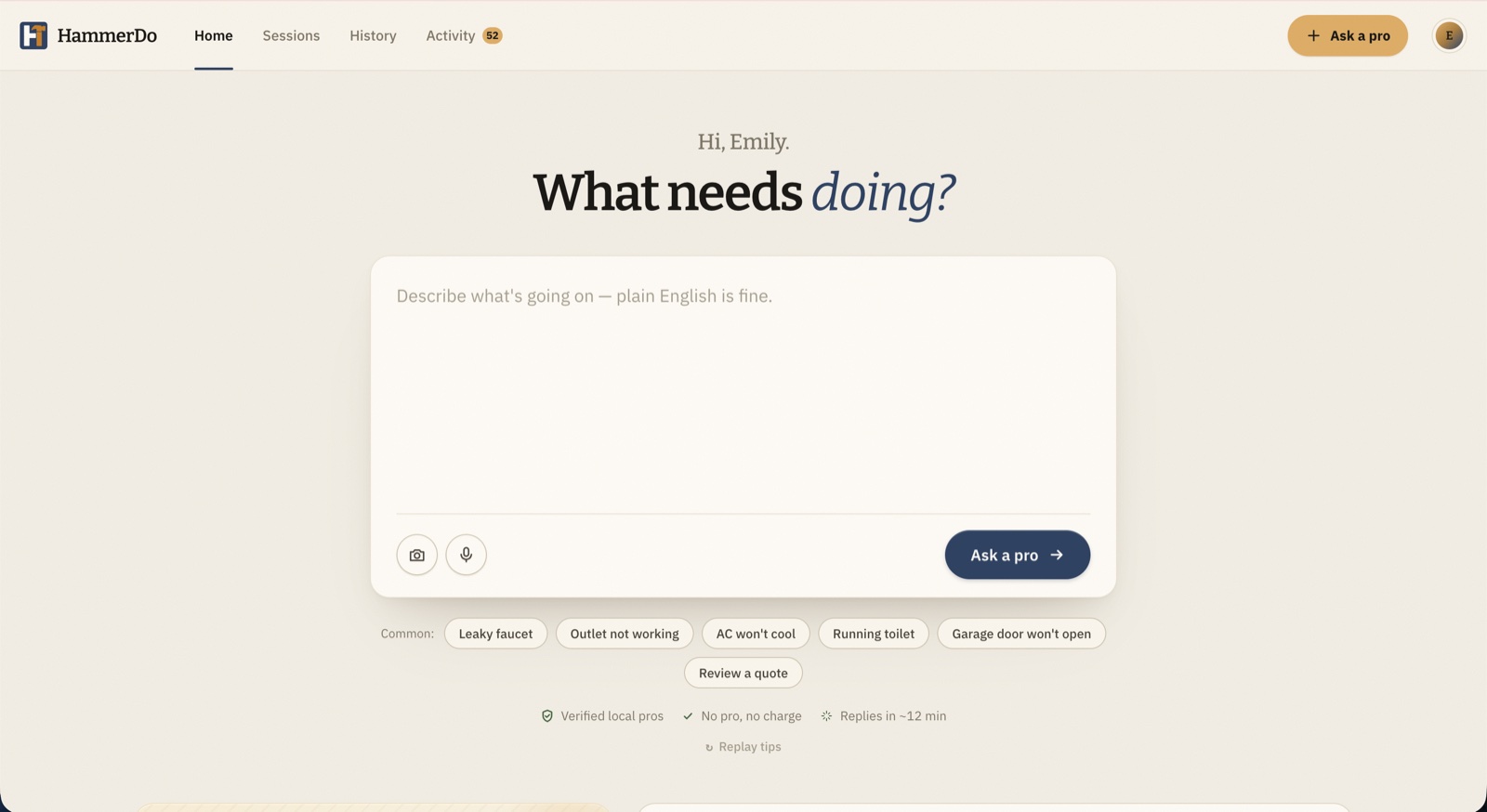
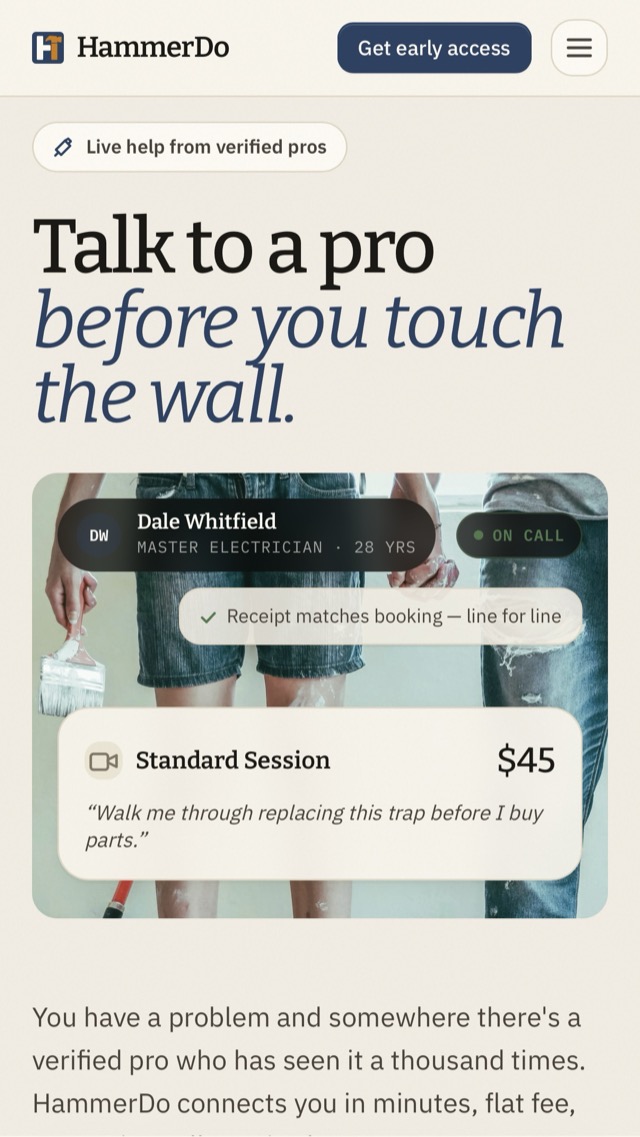
Talk to a verified trade pro before you touch the wall. Flat price, no service call.
Home-improvement help comes in two sizes: a full service call, or a forum full of guesses. HammerDo is what goes in between.
Problem
Home-improvement help jumped from free guesses to a full service call. There was no simple way to pay a skilled person for one specific answer.
My role
I took it from a problem I encountered in 2019 through product definition, design, copy, code, pricing, trust, payments, and the operating model.
Scope
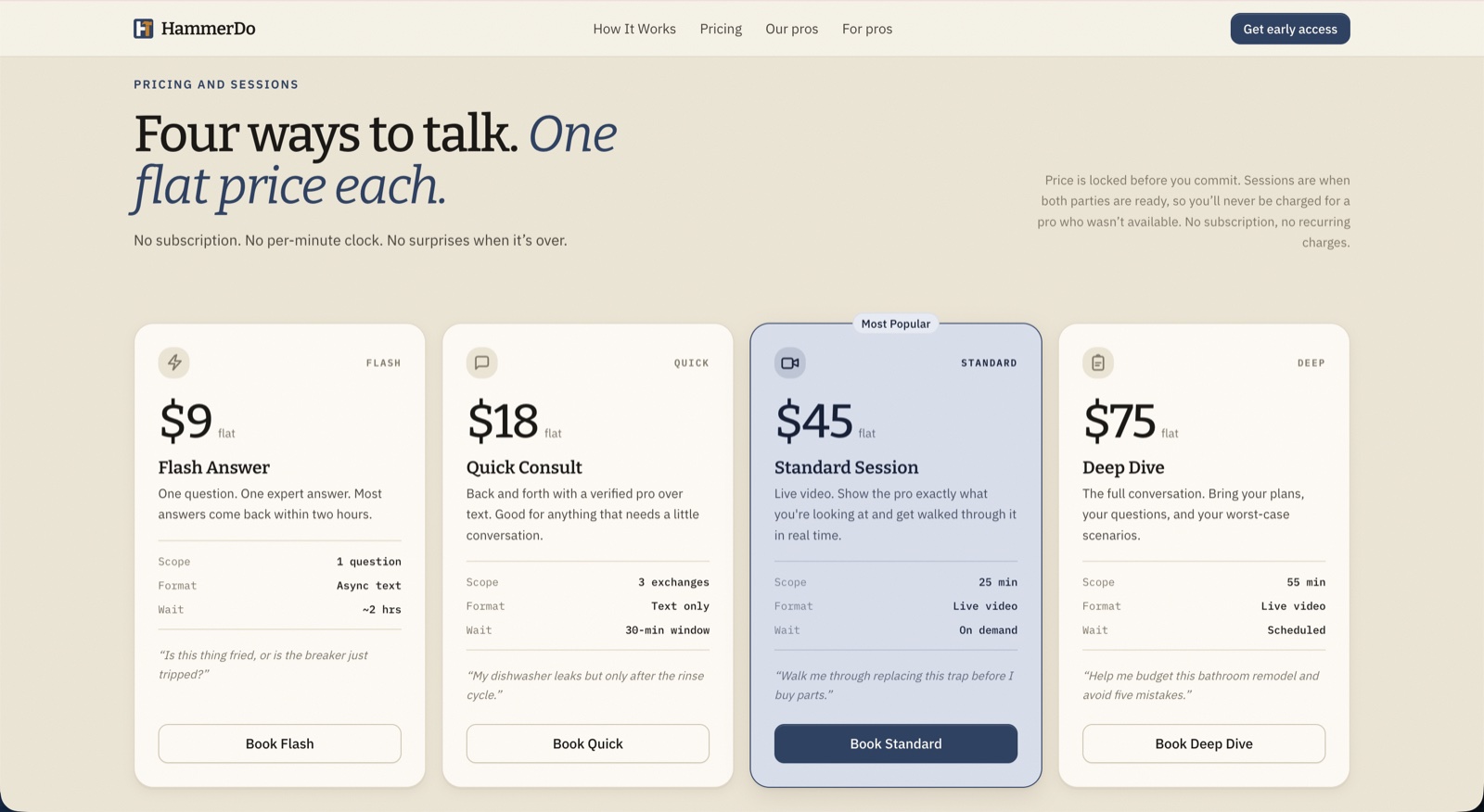
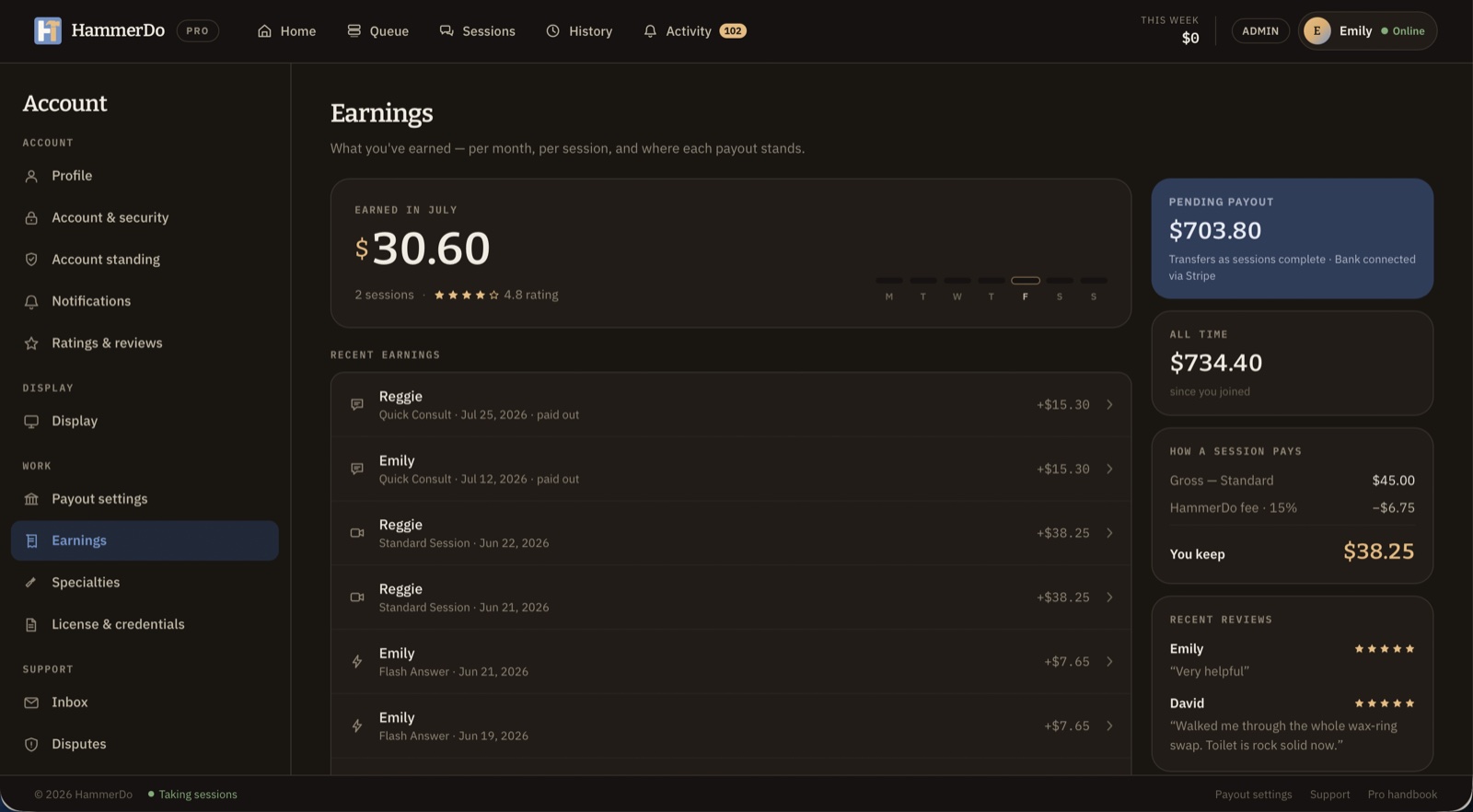
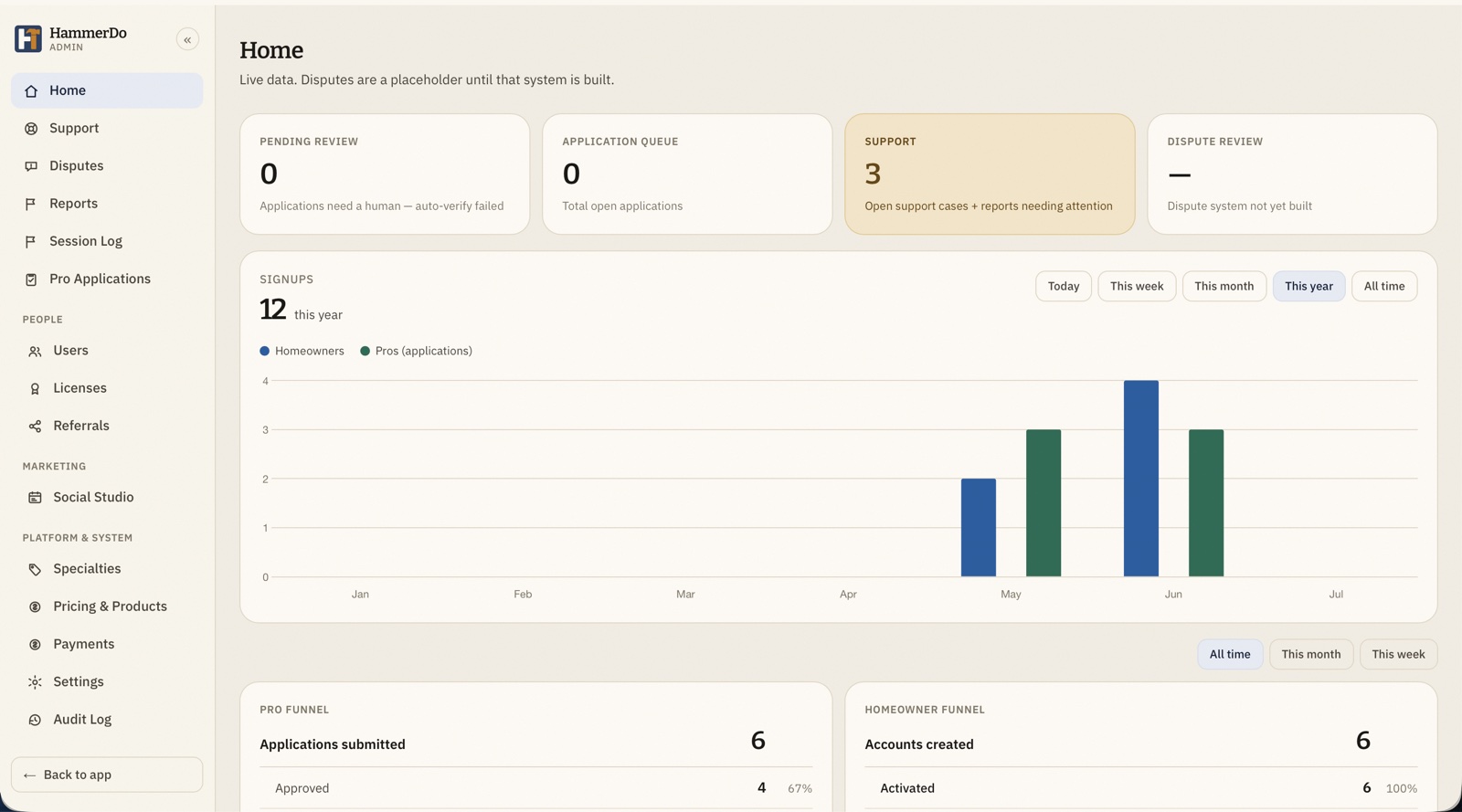
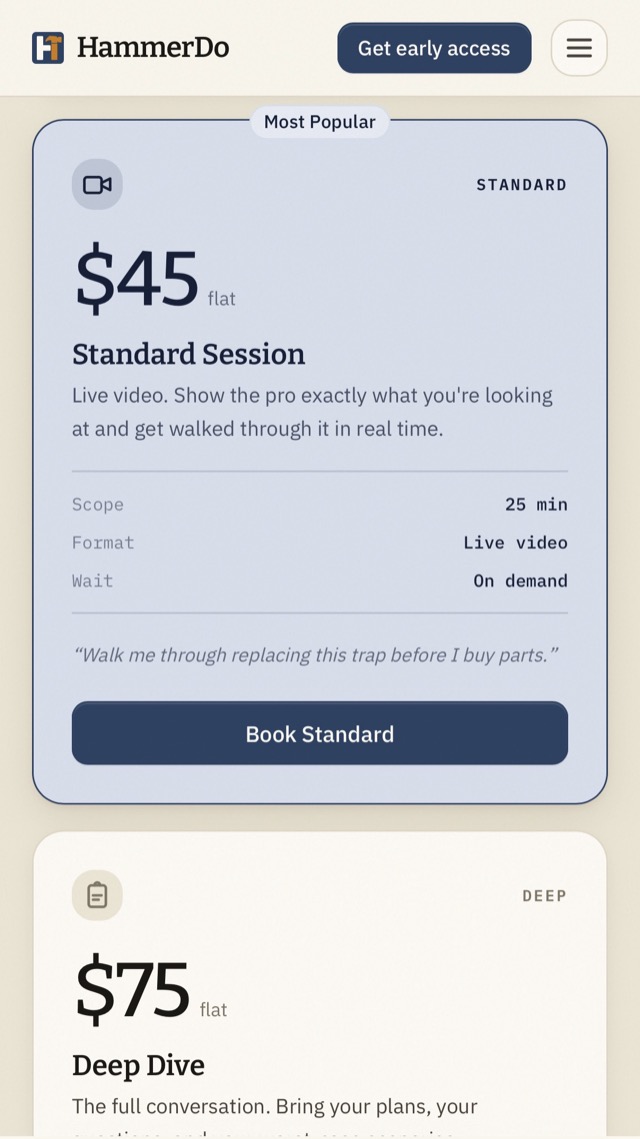
A two-sided marketplace with four flat-price session types, separate homeowner and pro experiences, an admin back office, and roughly 80 pages across product, support, and operations. Fixed costs are $63 a month and break-even is 21 sessions.
What changed
The idea became a working early-access marketplace with the core transaction and operating model built together. A pre-build review turned ten potential failure points into explicit decisions and documents.
What this demonstrates
I can build a zero-to-one marketplace while treating trust, economics, legal risk, and operations as product work from the start.
The gap between “I’ll just Google it” and a $200 service call.
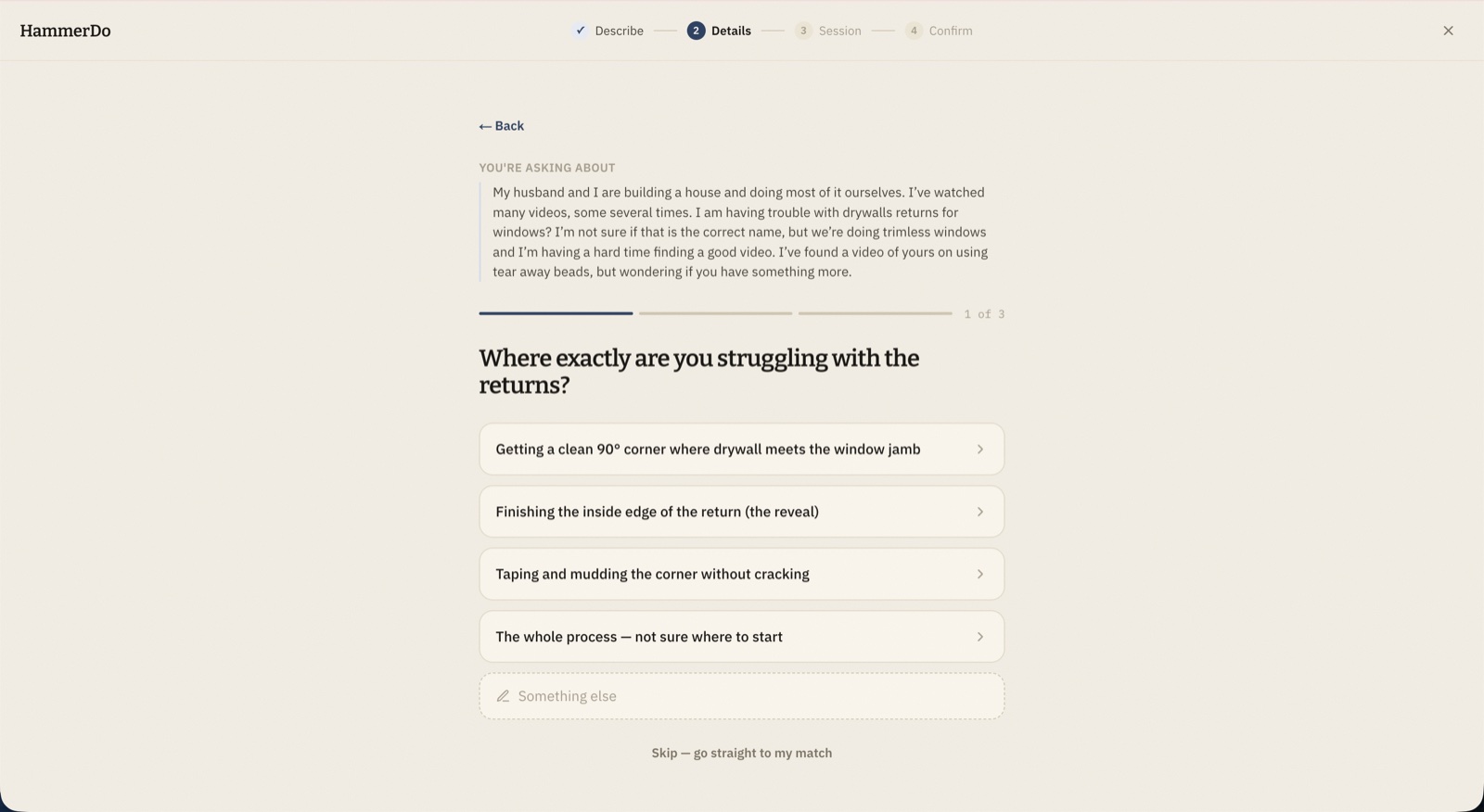
I learned to hang and tape drywall from a guy on YouTube and I’d watched everything he had, some of it more than once.
Then I got to the trimless windows. He didn’t have a video on returning drywall into them and I couldn’t find anyone who did, so I emailed the person who taught me and sent photos of my actual windows.
(The Drywall Doctor taught me everything I know about drywall, and he answers his email.)
I’m not sure what kind of gap to leave between the edge of the drywall and the window.
No more than 1/4 inch. Those are aluminum windows, you might want to put wood on the bottom. Drywall may not hold up when the windows start to sweat from condensation.
I asked about a gap. He answered it, then flagged a problem I didn’t know I had. There was no way to pay him for any of it. Nothing sits between watching everything a person made and paying to have them come out. That’s the product.
Flat price, not a meter
Per-minute earns more and puts a clock in front of someone whose kitchen is flooding. Four flat prices instead, all shown before you commit. The cheapest one barely clears the payment fee. It stayed anyway, a $9 question is the only reason a skeptical homeowner tries the product at all.
The trade: less money on every session that runs long.
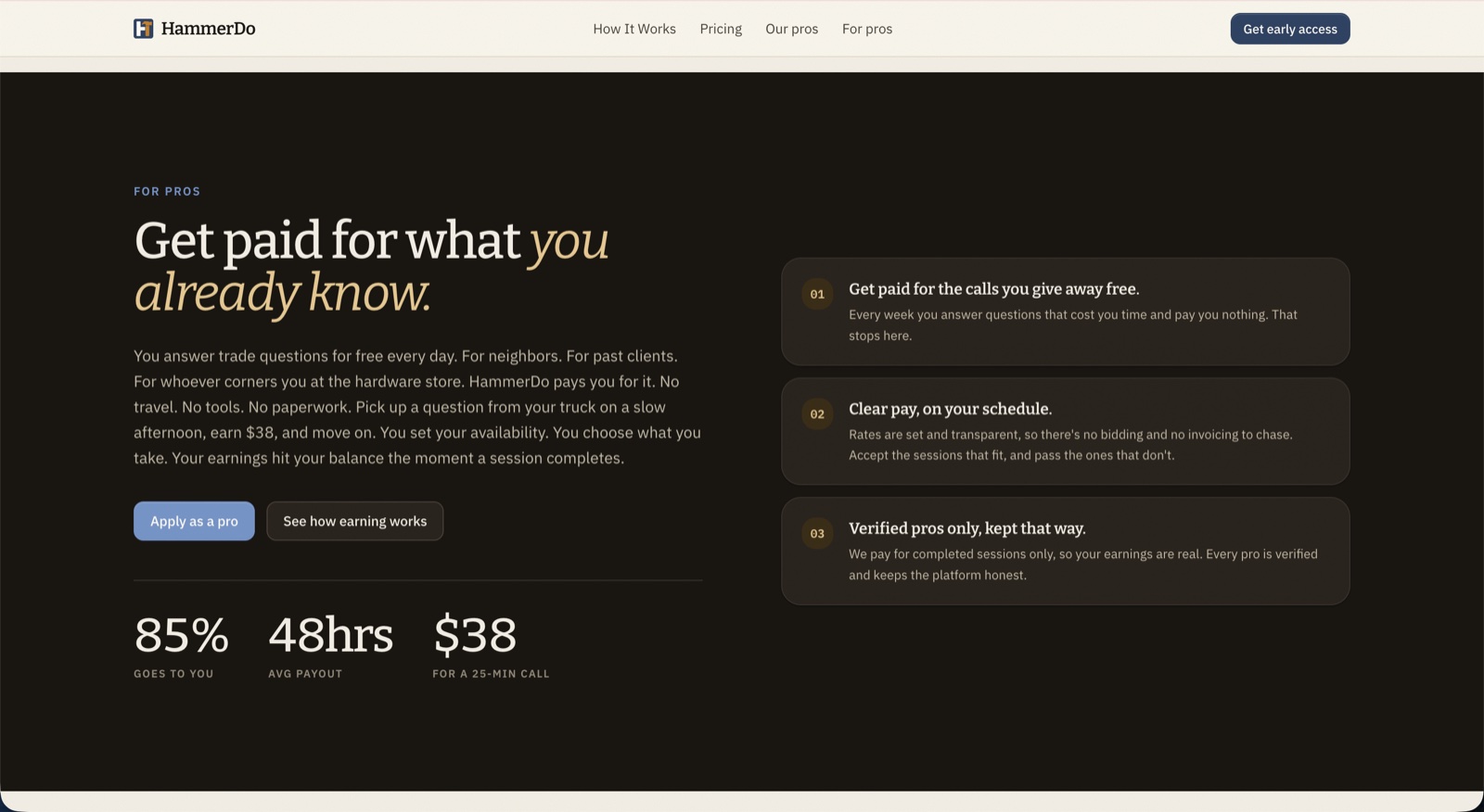
85% to the pro, permanently
Most platforms in this category take a fifth to half of what the expert earns. Pros work out where they’re being squeezed and leave, which is why supply on those platforms is what it is. The take rate is the acquisition budget for the harder side of the market.
The trade: a smaller cut, betting that better pros are worth more than the difference.
Verified, not licensed
Not every trade requires a license, so “licensed” was inaccurate and an exposure at the same time. One word, pulled out of the whole product. Took an afternoon to catch and would have taken a lawyer to unwind.
The trade: slower onboarding, verification is a real gate.
Both sides rate, not symmetrically
Reviews of a pro are public, a pro is a business. Written reviews of a homeowner stay admin-only, a browsable file on a private consumer is a defamation problem. Neither side sees the other’s until both submit.
The trade: a second rating system to build, and moderation to run on both.
Both sides at once
Booking, application, matching, and payout had to work together. Launching one side alone gives you a number you can’t read.
The trade: nothing worked at all until both halves did.
One app, no App Store
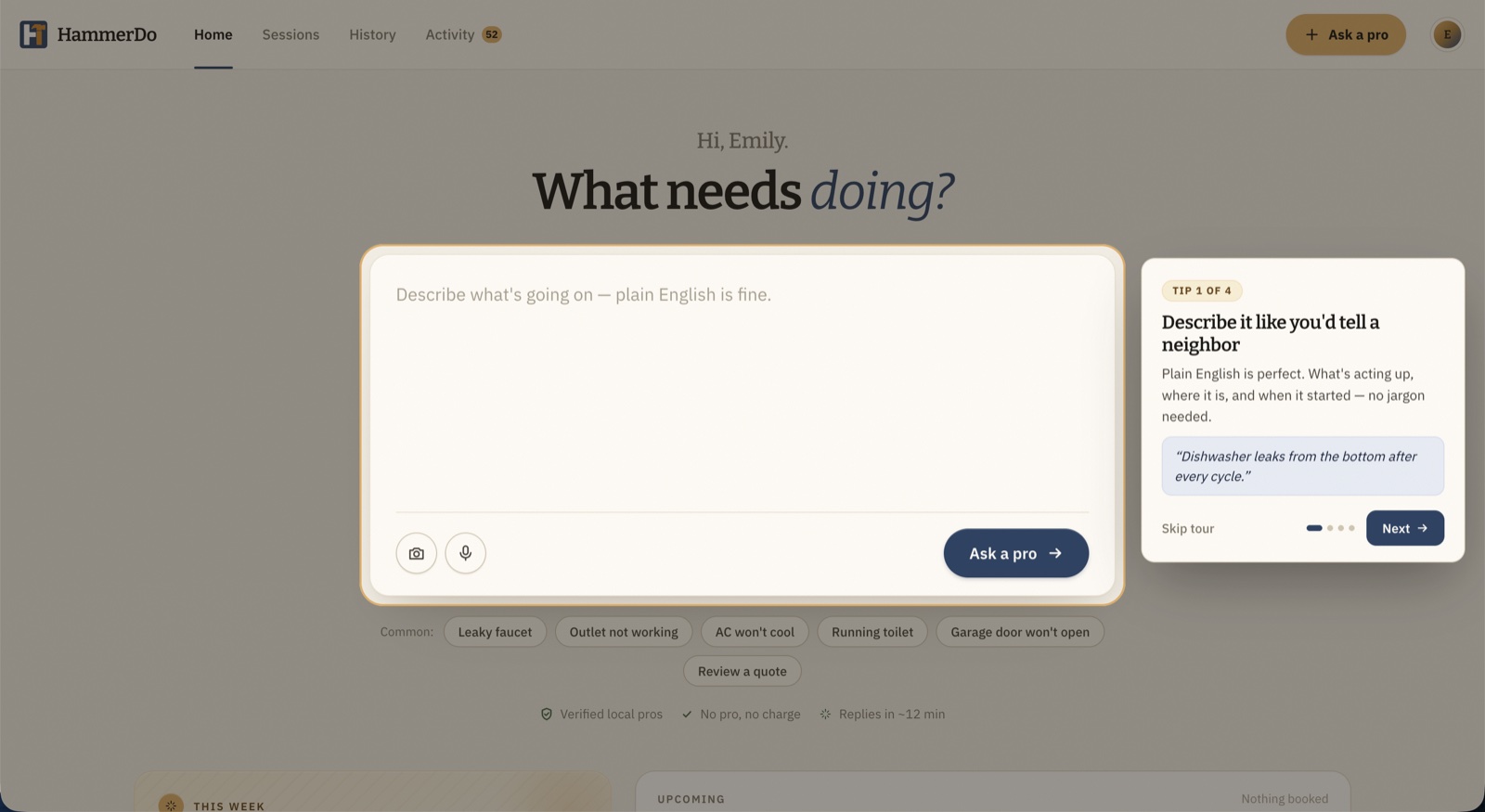
Homeowners and pros run on one codebase with role-gated routes. Two apps would have meant two pipelines, two auth systems, and a session record that belongs to both people living in two places. It installs to a phone as a PWA, so a pro gets push notifications without a three-week App Store review in the way.
The trade: PWA push has edge cases on iOS, and native is a v2 problem I’ve deferred rather than solved.
I asked what would kill it.
The PRD was done, so I had the whole thing reviewed with one instruction. Not “is this good.” Find the reasons it fails.
Ten came back.
All ten turned into documents. The review is still up, unedited.
Per-minute pricing
Earns more, feels like a taxi.
Public written reviews of homeowners
Pros still rate them and the average is visible where it’s useful. A named, browsable file on a private consumer is a reason never to come back.
Contractor dispatch
The most requested thing, and the fastest route to becoming a liability company.
Subscriptions
The obvious revenue move, and the thing that put the market leader in court.
Inside the product
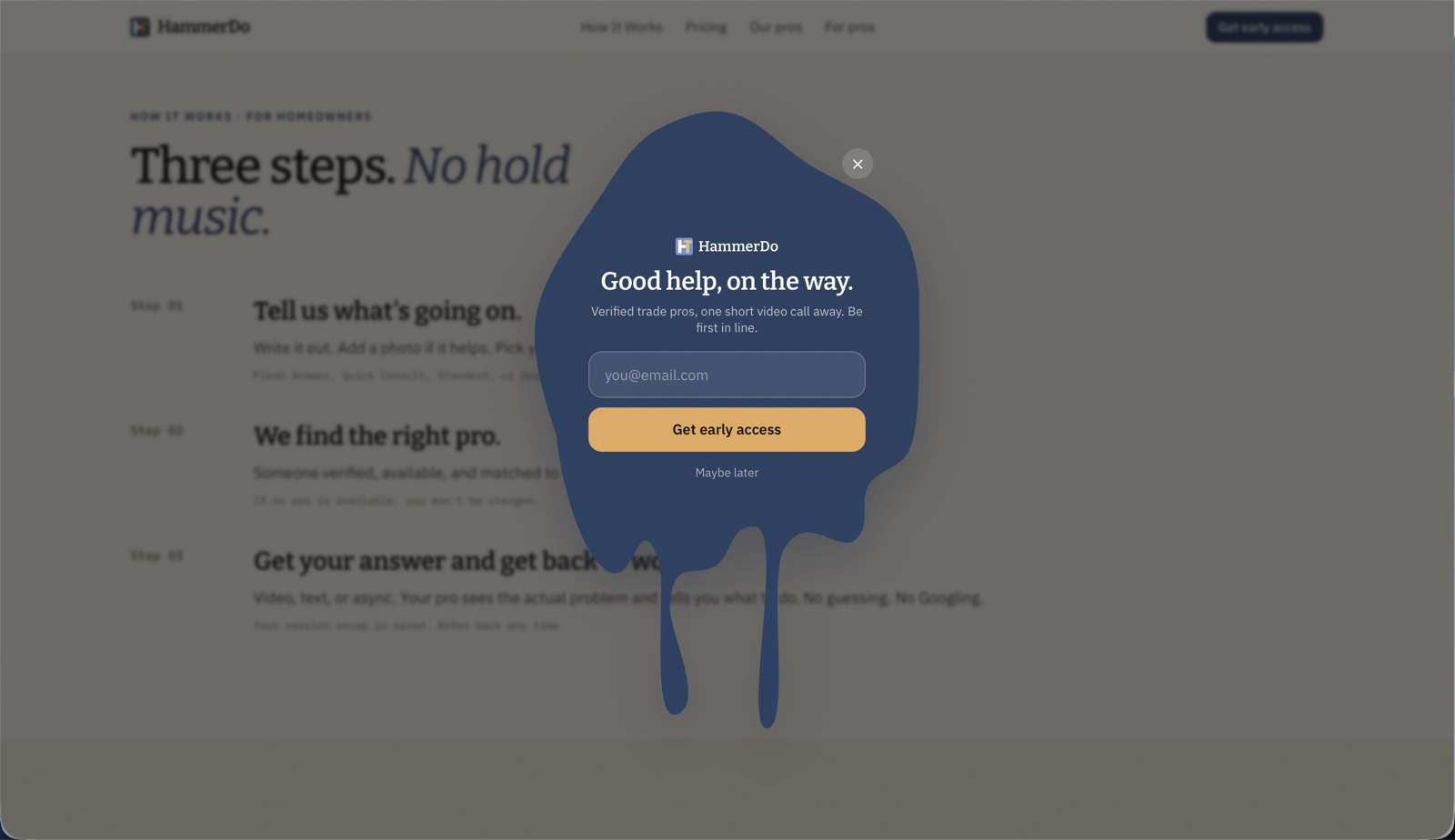
scroll →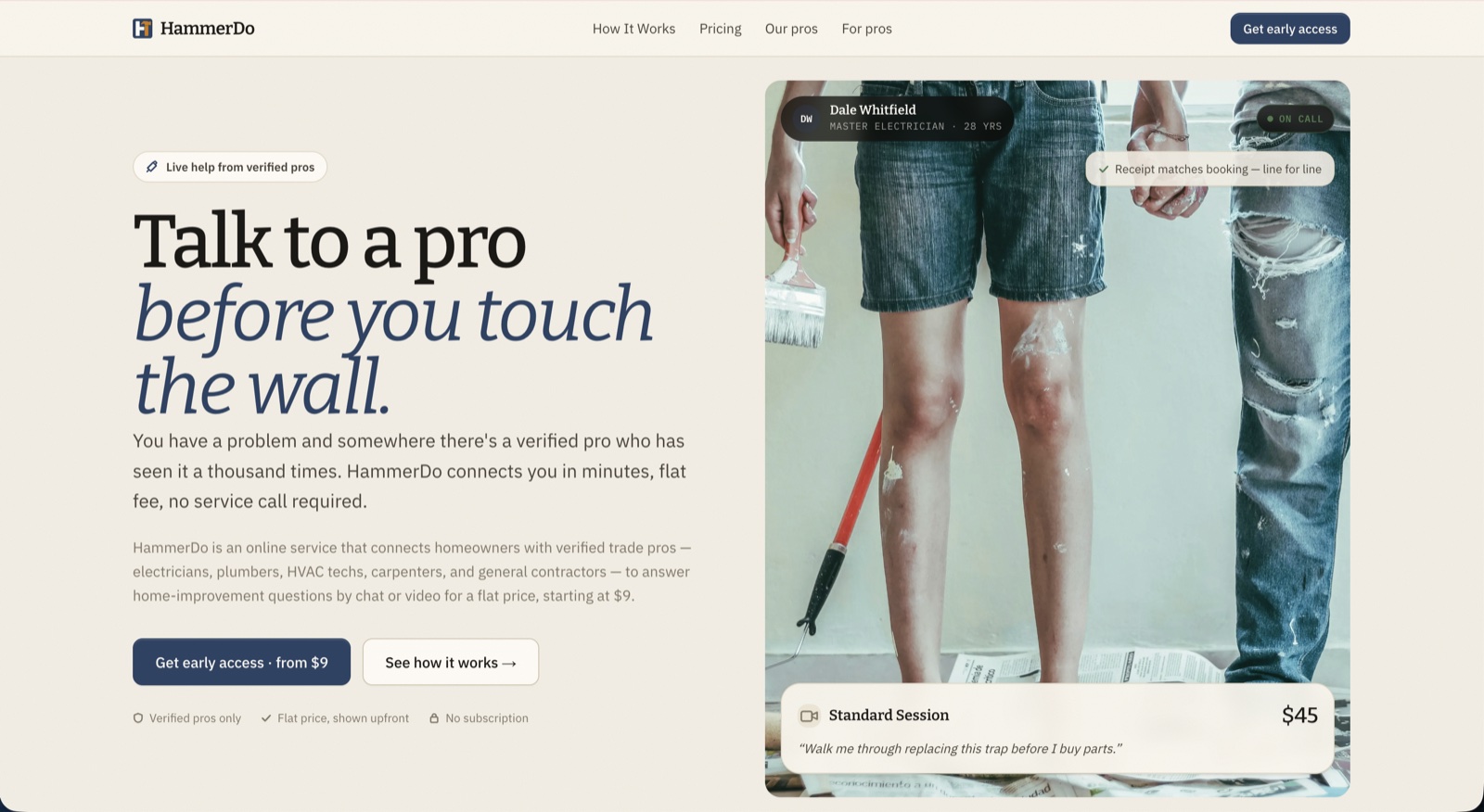
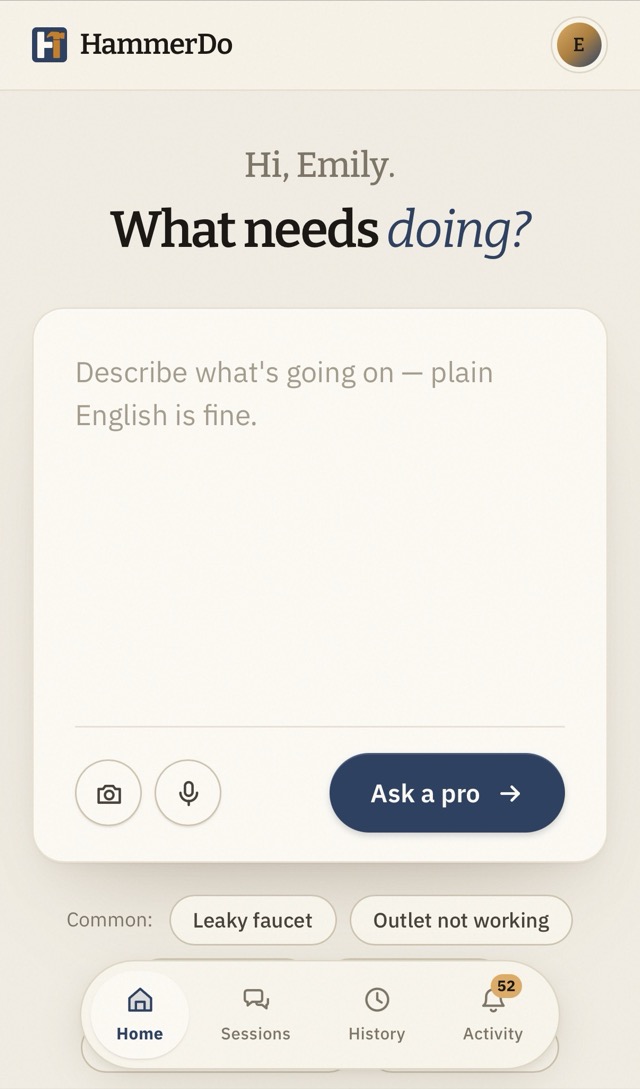
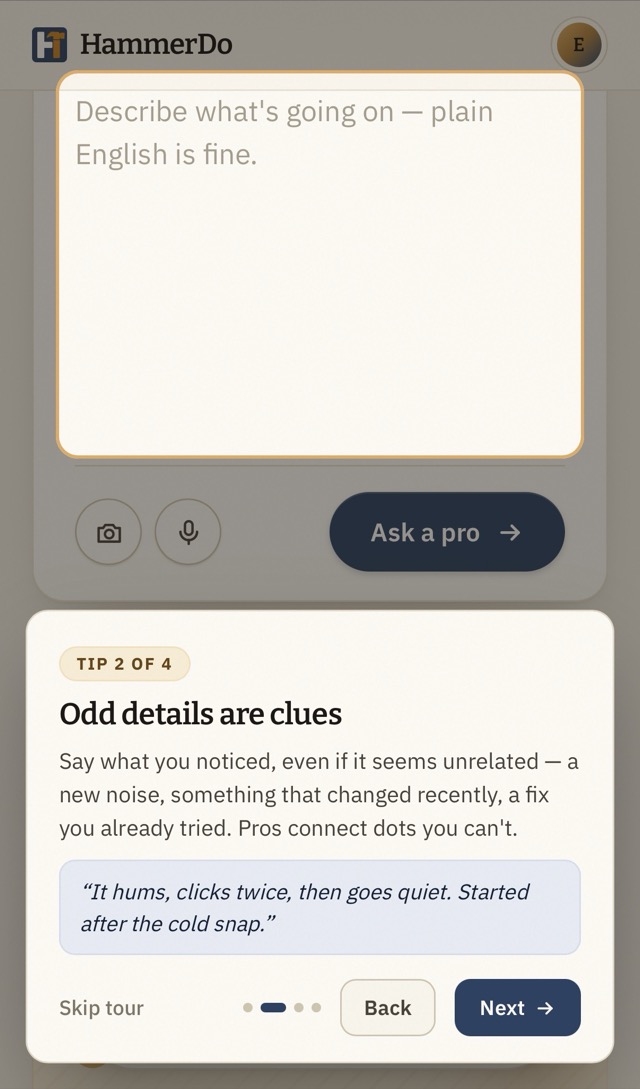
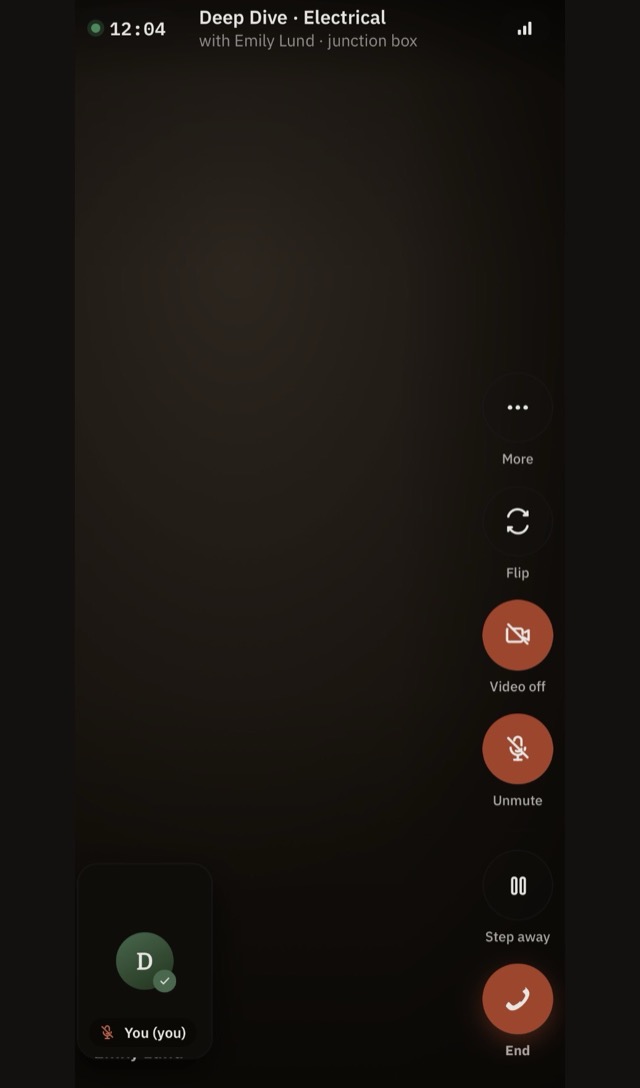
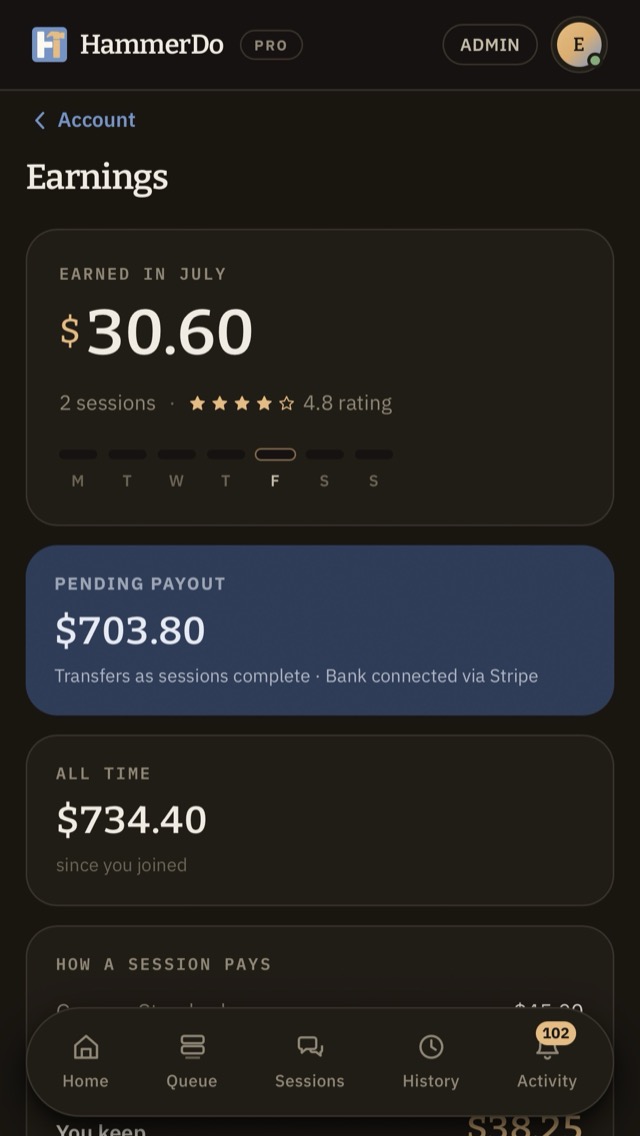
Supportive contractor dad who cannot believe what you just did.
Roast the situation, never the person. “This drywall patch lost a fight” works. “You have no idea what you’re doing” doesn’t. Everything lands on the reassurance, stopping at the roast is just mean.
Different register from this page, on purpose.
Eighty pages, a PRD at v0.7, Jira epics that point back at the specs instead of replacing them. Every open item carries one of seven flags: legal, copy, content, design, data, product, or CS. Resolving one means checking whether it made work in another, and resolved flags keep their reasoning rather than getting deleted.
Fixed costs are $63 a month and break-even is 21 sessions, which is the whole reason there’s no investor.
Live in early access. No usage numbers yet, ask me in six months.
Talk to a pro before you touch the wall.
One project on the registry. Need the same thinking pointed at your product? Bring me into the work.